Train of Thought
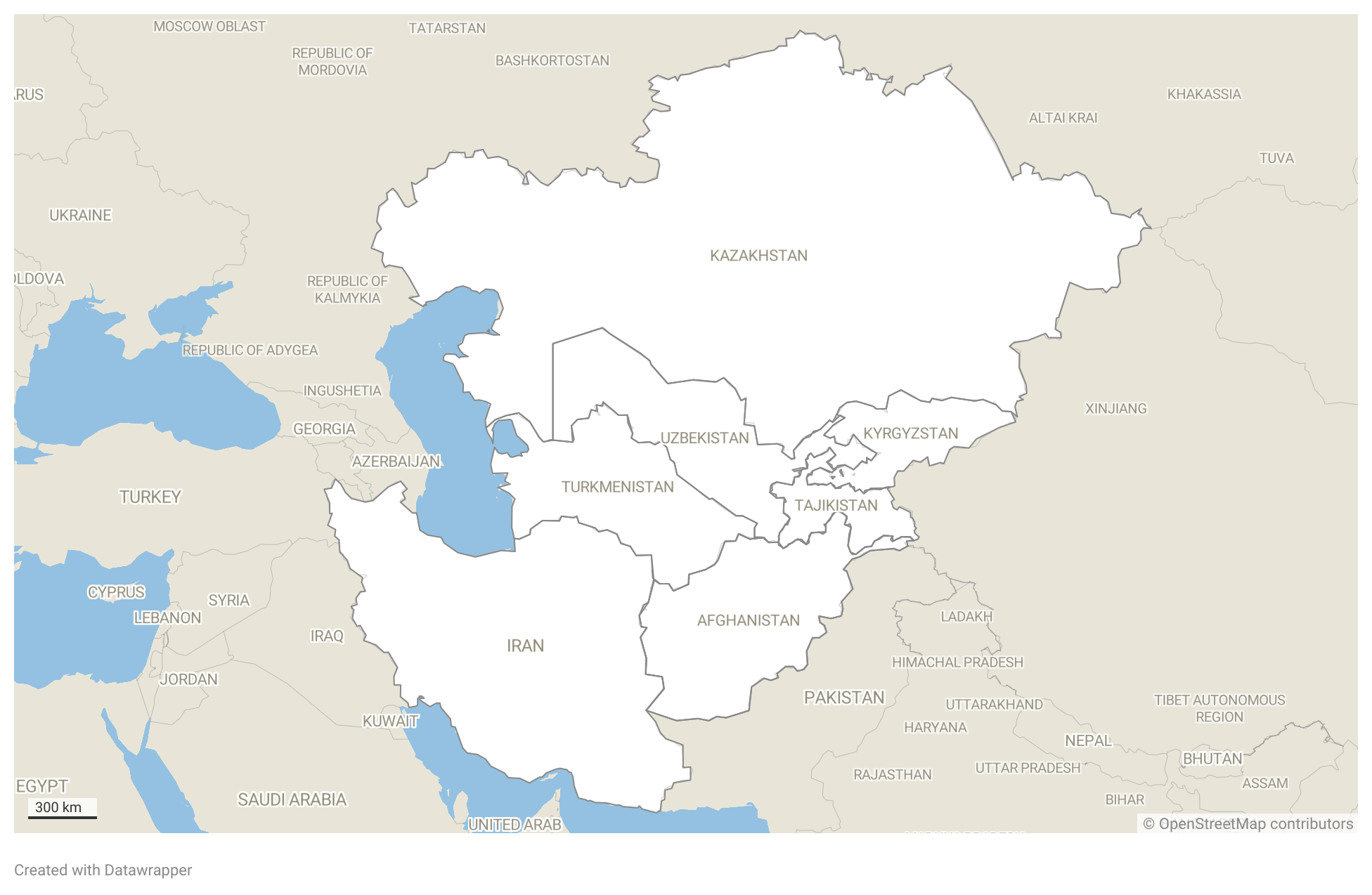
We are an independent research group studying freight railways and their supply chain connections in Iran, Afghanistan, Uzbekistan, Kazakhstan, Tajikistan, Kyrgyzstan, and Turkmenistan.
This site showcases our research. We share our analysis, expertise and custom datasets that present complex freight transport developments and supply chain issues in an accessible and actionable way, for fellow researchers and decision-makers across government and industry.
Our research contributes to supporting the UN’s SDG goals (7, 9, 12 and 13) in developing economies in ensuring inclusive, accessible and sustainable transport infrastructure.
Our research has been published in the Royal United Services Institute (RUSI) and the International Railway Journal (IRJ).
Meet the Team
-

Sophia Nina B-A
FOUNDER & EDITOR
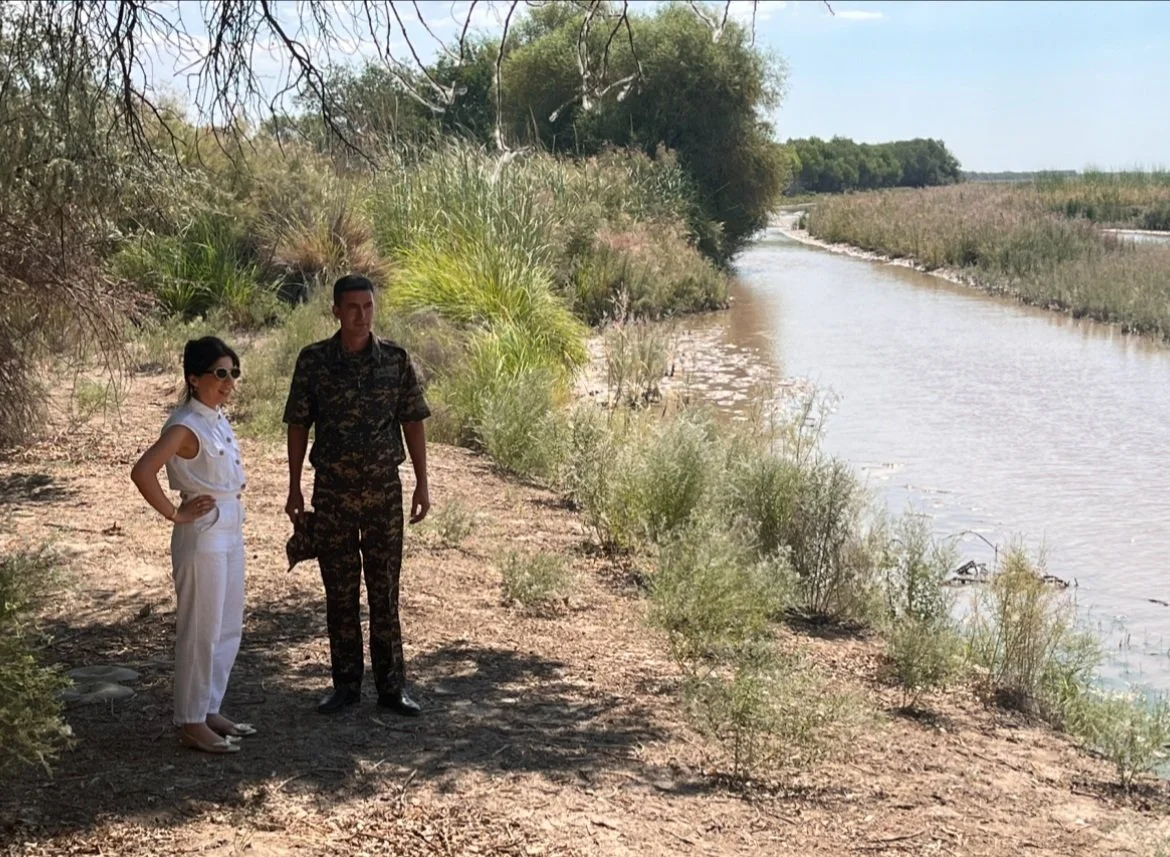
Sophia Nina B-A is a Russian, Dari, and Uzbeki speaker with experience in delivering sustainable economic development in emerging markets. Sophia founded Train of Thought in June 2024.
Her background includes geopolitical and market risk analysis roles in the UK business investigations and due diligence industry, and the World Bank Group’s IFC, based in Uzbekistan and Tajikistan. She has spent over a decade living and working in South and Central Asia.
Sophia currently serves as an independent freelance consultant, working with international development banks, private equity and global firms to build risk strategies in their portfolio at the intersection of geopolitical risk and global sustainability.
She has published 35 articles with bylines in RUSI, The International Railway Journal, The Diplomat, Le Monde, The BBC, and The Economist.
-

Mads Schmidt
SECURITY EXPERT
Mads Schmidt is a security and risk-management practitioner with experience in fragile and high-risk environments. Mads joined Train of Thought in August 2025.
His background includes operational roles with Danish and Norwegian diplomatic missions in Afghanistan and subsequent work in security consulting for international clients.
He currently serves as Physical Security Lead at Novo Nordisk in Denmark, where he is responsible for national security governance, incident preparedness, and the development of standardised security frameworks across multiple sites.Mads professional interests include critical-infrastructure protection, resilience, and the interaction between security conditions and business objectives.
-

Charles McCloy
COLD LOGISTICS SUPPLY CHAIN EXPERT
Charles is a Russian & Arabic speaker with specialism in cold logistics and food business across international markets. Charles joined Train of Thought in November 2025.
He currently works as a Director at CBRE, where he provides strategic real estate advice to clients across the globe in the cold logistics and food sectors.
He has a particular professional interest in the economic potential of Central Asia and advises clients on how to navigate the region.
Charles is experienced in consulting on the valuation, financing, development, and M&A of food facilities on behalf of leading investors, operators, and lenders in the sector, having provided over €7 bn in advice.
Our research
-
![]()
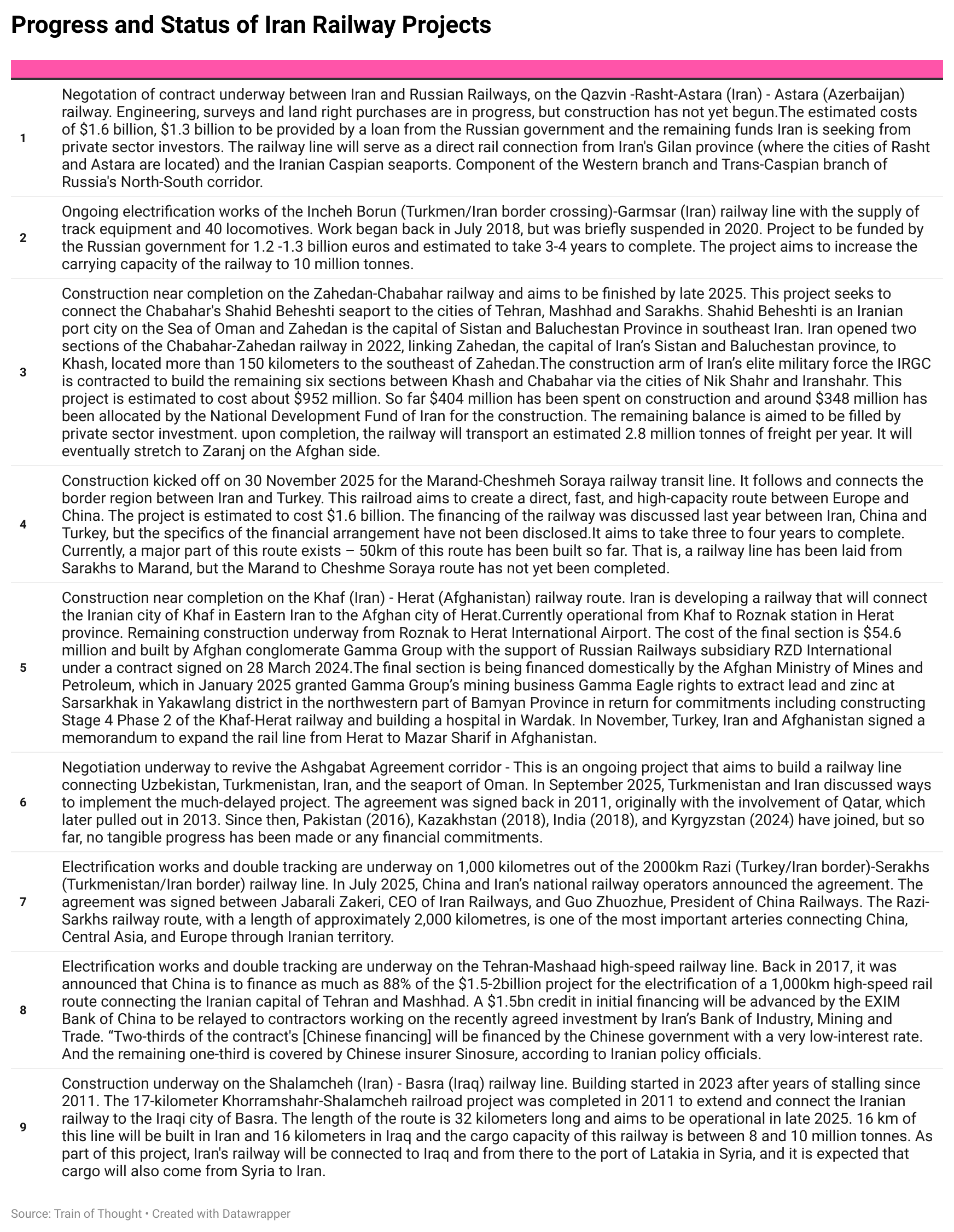
Summary of progress and status of Iran’s Freight Railway projects
28/01/2026
By Sophia Nina B-A
I have created a table summarising all the ongoing and planned major railway connections in Iran. I have detailed the status in the table also. Just a way for me to stay on top of projects and analyse developments! Definitely a trickier research task, but interesting nevertheless.
-
![]()
The Cold Chain in Uzbekistan
19/01/2026
By Charles McCloy
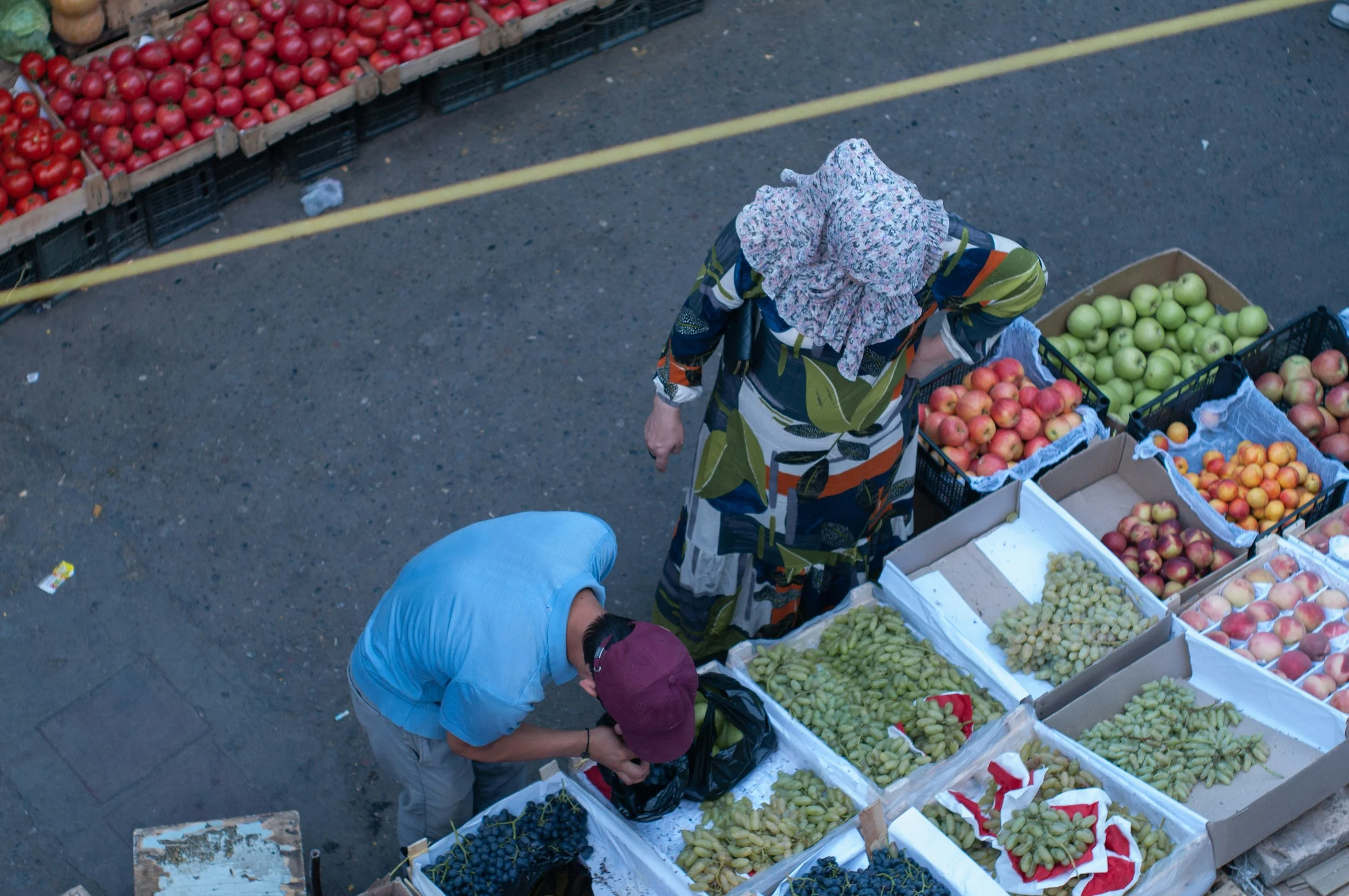
In the second article of our series about the food security in Central Asia, we will take a closer look at the cold storage sector Uzbekistan.
Our cold supply chain expert Charles McCloy his penned down his insights on the current state of the cold storage sector in Uzbekistan, provided a handy market overview of the cold supply infrastructure and logistics industry, and offered a rundown on where the cold chain needs to adapt to stay ahead of emerging trends.
The question is no longer whether geopolitics will affect supply chains, but whether value chains are built to endure it.
-
![]()
Feeding a Growing Population: Logistics Challenges Facing Food Security in Central Asia
25/11/2025
By Charles McCloy
With the recently signed ‘Central Asia Food Security Plan through 2030’ by the Central Asian agriculture ministers on 11 November in Uzbekistan, Charles has crunched the data and has put together his first in a series of articles exploring the cold supply chain in Central Asia, and how it affects food security in the region. He unpacks: where we’re at now, what’s causing the logistical challenges and offers practical strategies to close the gap.
-
![]()
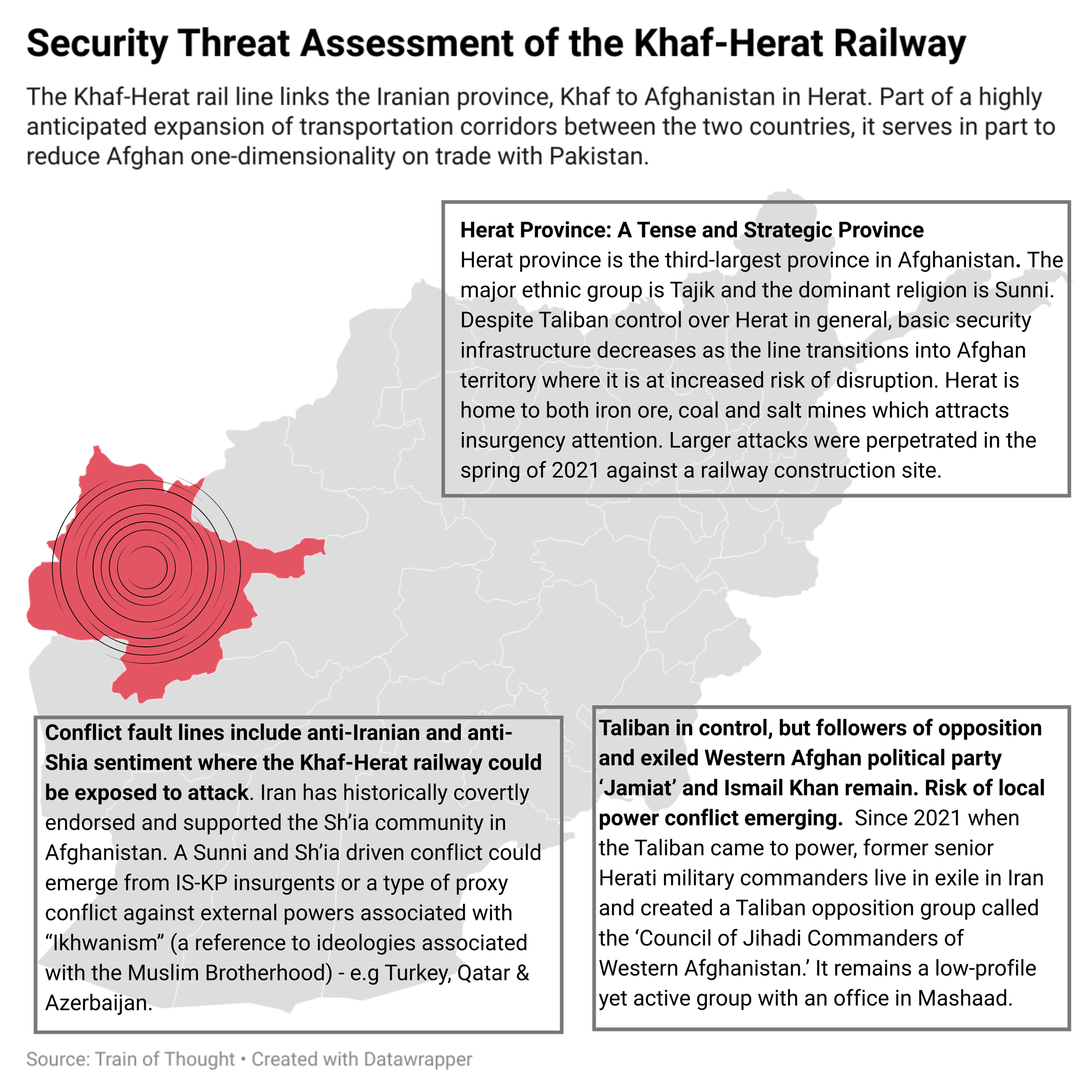
The Khaf-Herat Railway: Security Threat Assessment Map
21/11/2025
By Mads Schmidt
A high-level overview of the security risks along the semi-built Khaf-Herat railway route. We have provided a snap summary of the security context of Herat province in Afghanistan currently. Despite the Taliban being in control, Herat is the third largest province in Afghanistan and holds strategic significance to both Afghanistan as well as its neighbour Iran. This also exposes it to potential threats, as illustrated in the map.
-
![]()
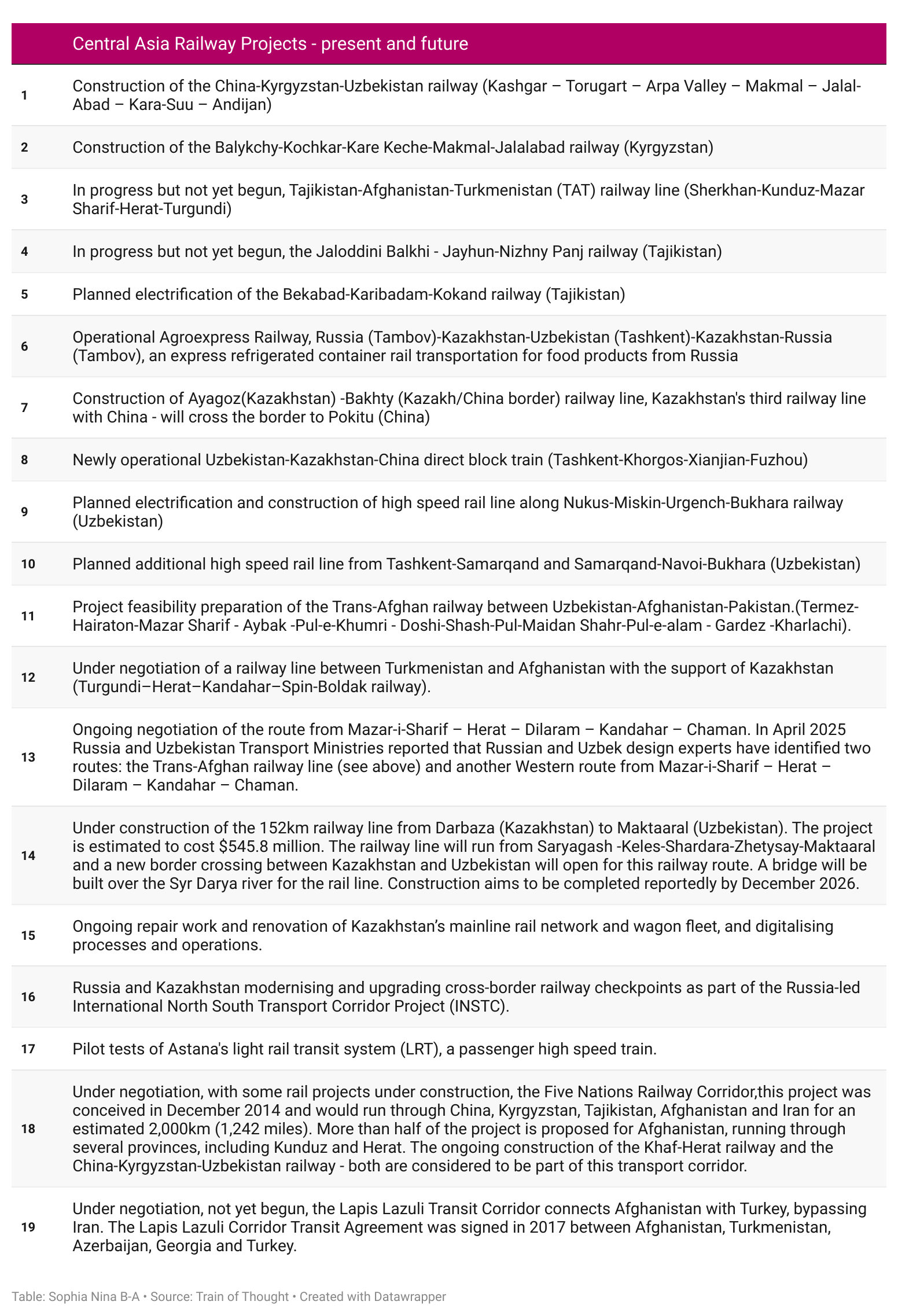
Updated Table on Central Asia Railway Projects - Current and Future
17/11/2025
By Sophia Nina B-A
I have just updated and simplified the previous table I published here on Central Asia railway projects. I felt a refresh was necessary! Hope this is clearer and easier to follow.
-
![]()
Russia begins first diesel export to Afghanistan via Iran railway
06/11/2025
By Sophia Nina B-A
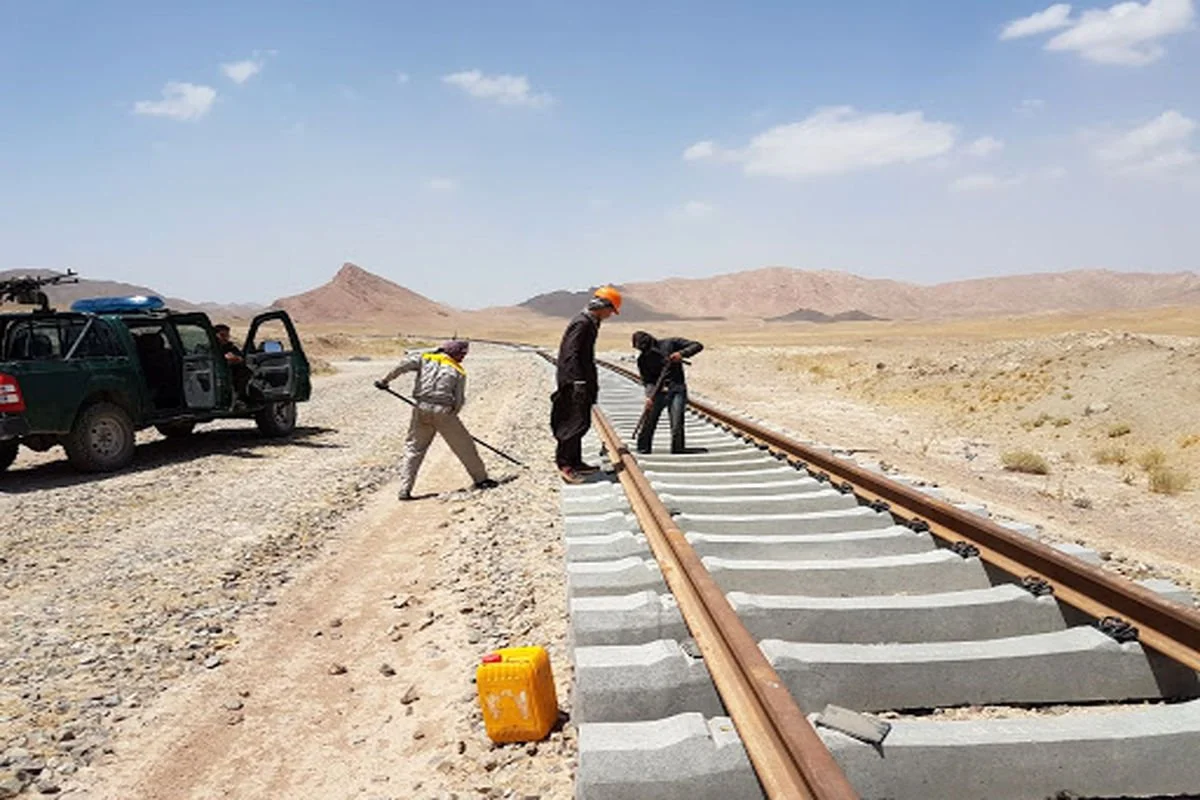
Yesterday, Russia reportedly started exporting 5000 tonnes of diesel fuel by railway for the first time to Afghanistan via Iran. The diesel fuel will be shipped from Russia to the Iranian Caspian seaport of Amirabad, from there the fuel is carried by rail to Mashhad then to Afghanistan via the semi-finished Khaf-Herat railway.
-
![]()
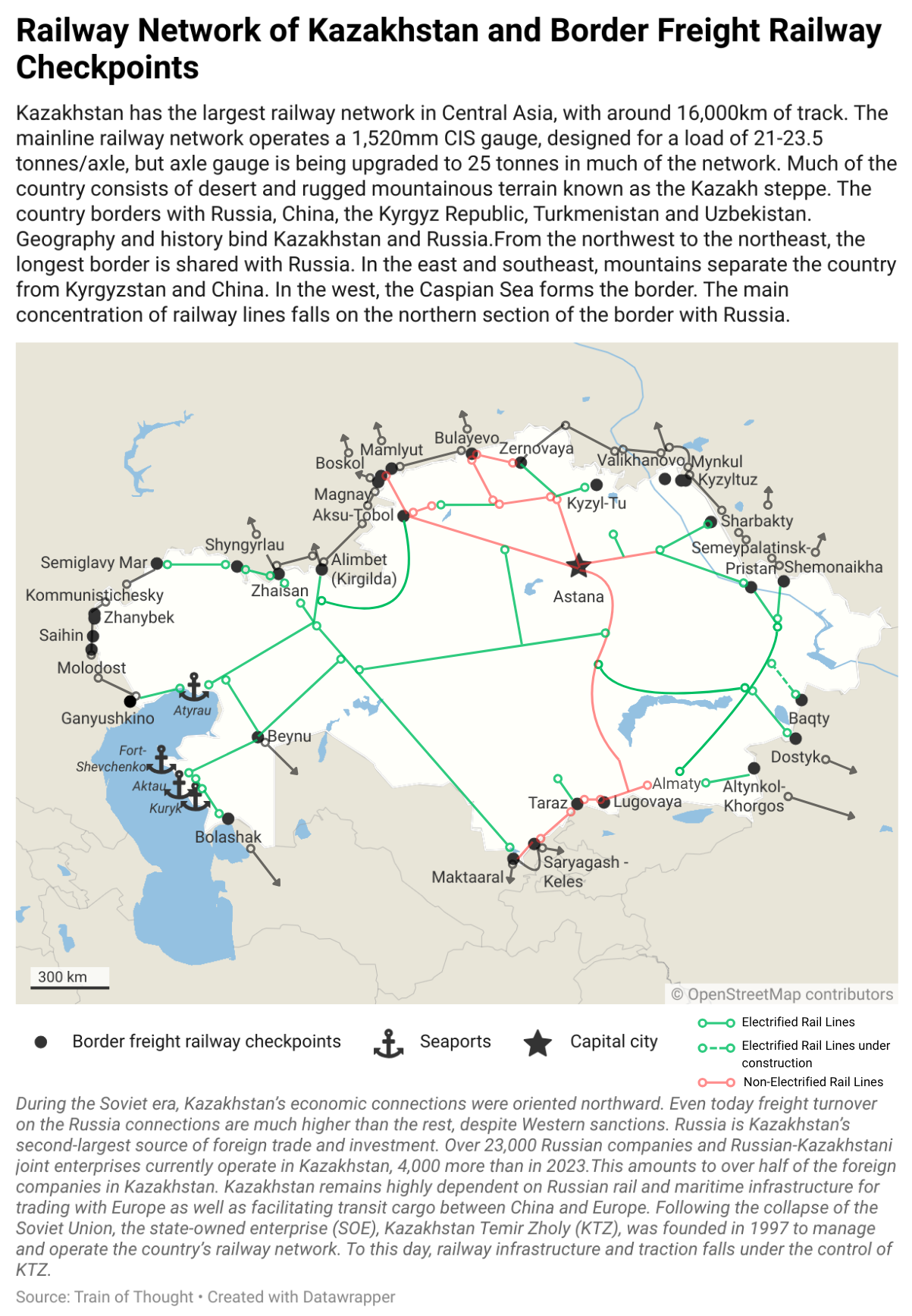
Railway Network of Kazakhstan and Freight border crossings
17/10/2025
By Sophia Nina B-A
In my latest research, I carried out an extensive examination of Kazakhstan’s railway lines and border crossings for freight movement.
-
![]()
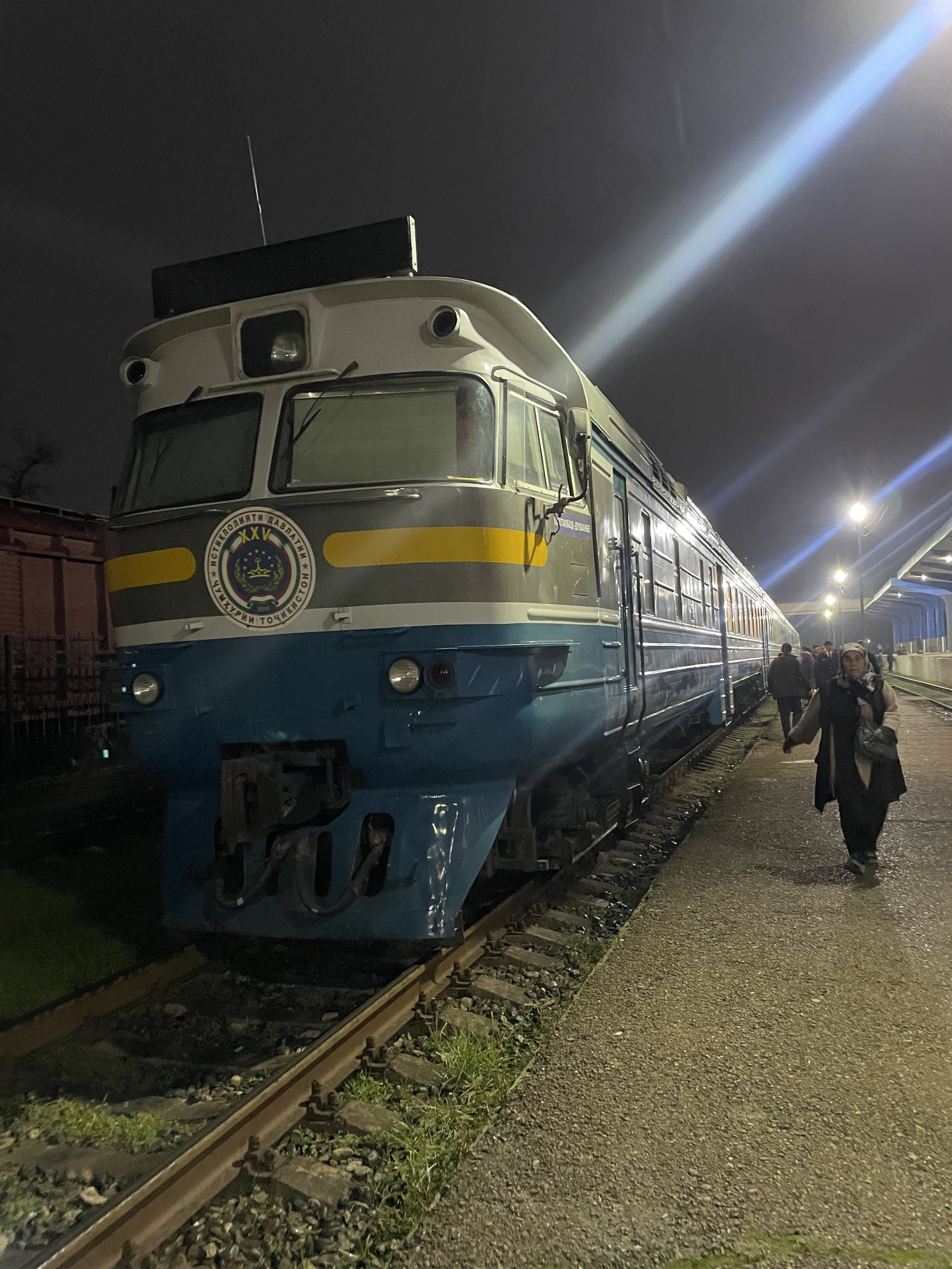
Overview of Tajikistan’s Railway Network
29/10/2025
By Sophia Nina B-A
I dive into the Tajik railway network and share my notes on the background of key rail projects.
-
![]()
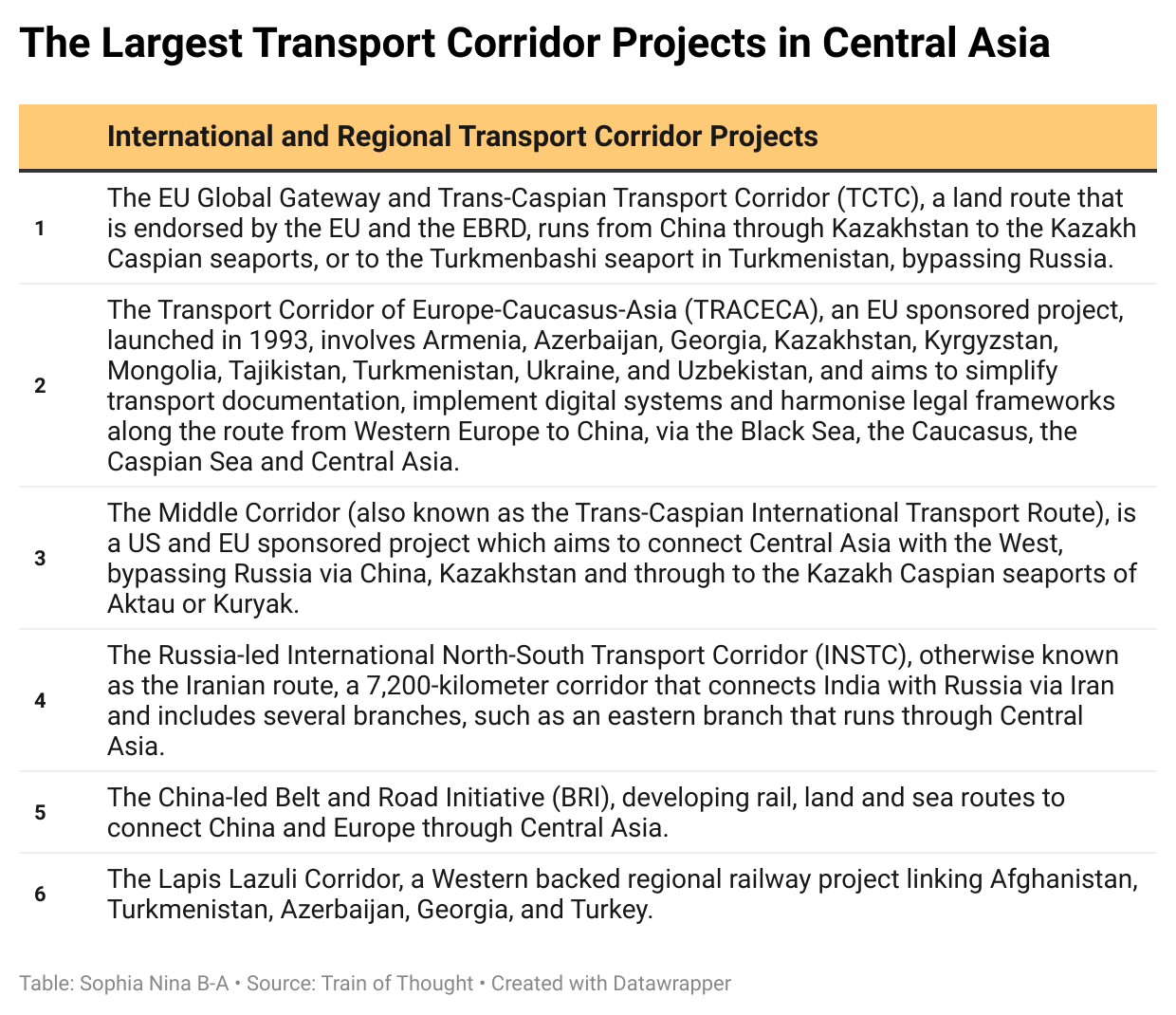
Railways of Central Asia - present and future
29/09/2025
By Sophia Nina B-A
A detailed summary of all railway projects-present and planned- going on in Central Asia, as well as the broader transport corridor projects they form a part of.
-
![]()
The Trans-Afghan Railway: Updates So Far
29/09/2025
By Sophia Nina B-A
In my recent article for RUSI I highlight the ambiguous role of Russian Railways in the Trans-Afghan railway project feasibility studies
-
![]()
The Khaf-Herat Railway: Summary Of Latest Developments
22/09/2025
By Sophia Nina B-A
Construction begins on the final section, Iranian delegation inspects progress, and further joint iron ore mining activities discussed.
-
![]()
The Khaf-Herat Railway: possible iron ore-for-railway deal and new border crossing
30/08/2025
By Sophia Nina B-A
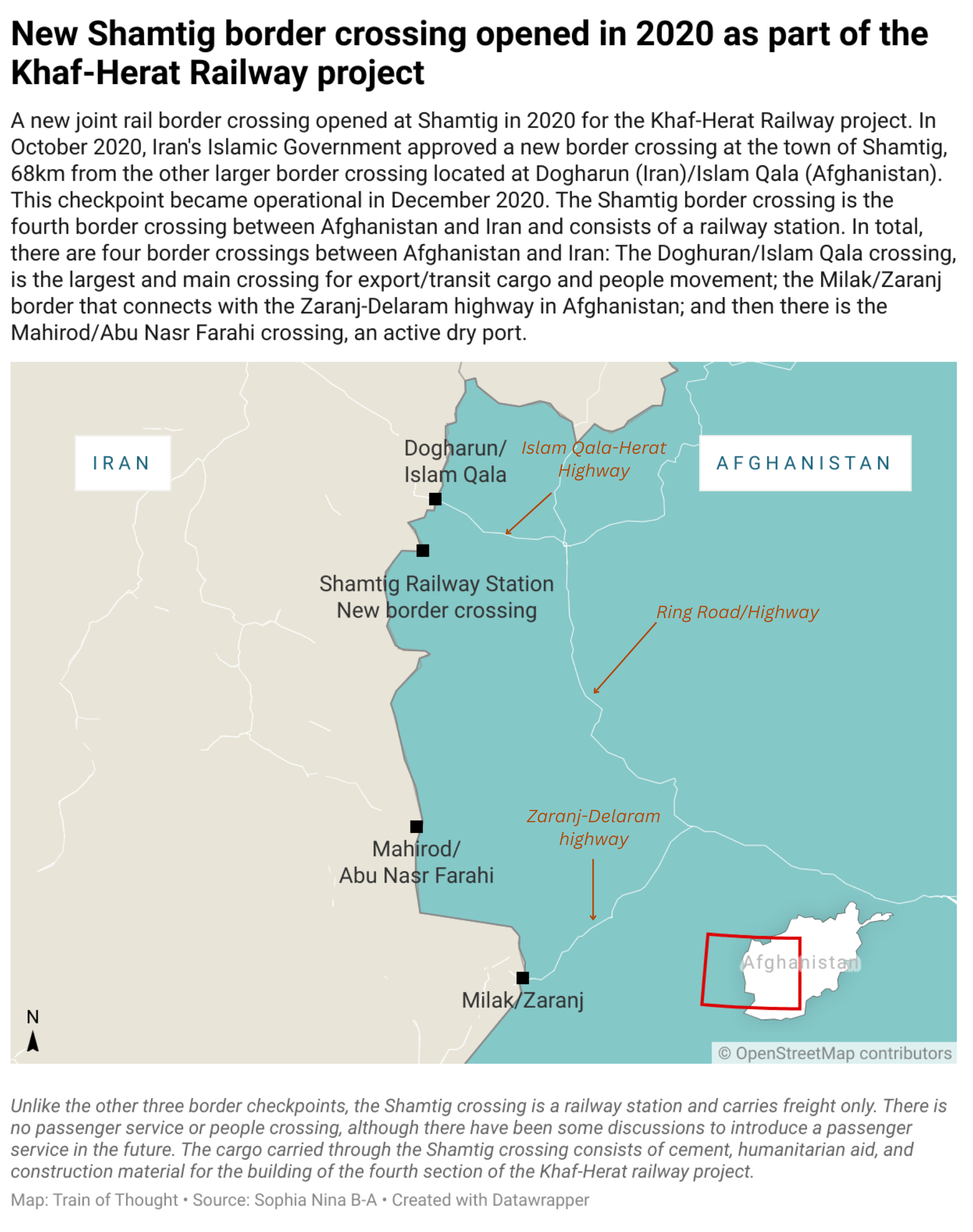
A closer look at the new Shamtig railway border crossing between Iran and Afghanistan, built for the Khaf-Herat railway project; and a possible iron ore in exchange for railway deal between Afghanistan and Iran.
-
![]()
The Khaf-Herat Railway Route
08/08/2025
By Sophia Nina B-A
Route map and breakdown of construction of the Khaf-Herat Railway project between Iran and Afghanistan
-
![]()
The Trans-Afghan Railway: Security Threat Assessment Map
08/08/2025
By Mads Schmidt
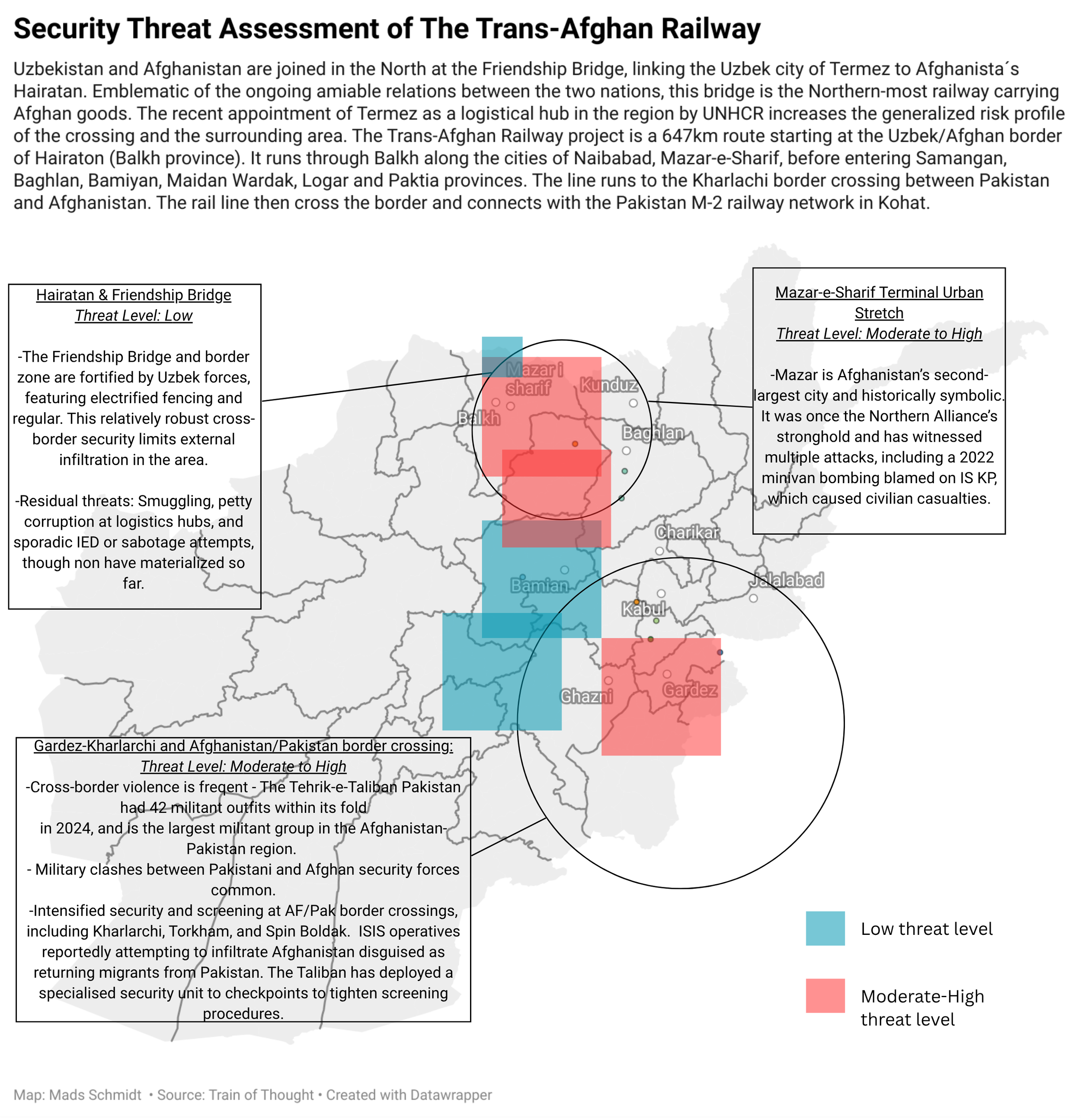
Security threat assessment map of the Trans-Afghan Railway
-
![]()
The Trans-Afghan Railway Route
31/07/2025
By Sophia Nina B-A
A detailed background and assessment of the Trans-Afghan railway project.
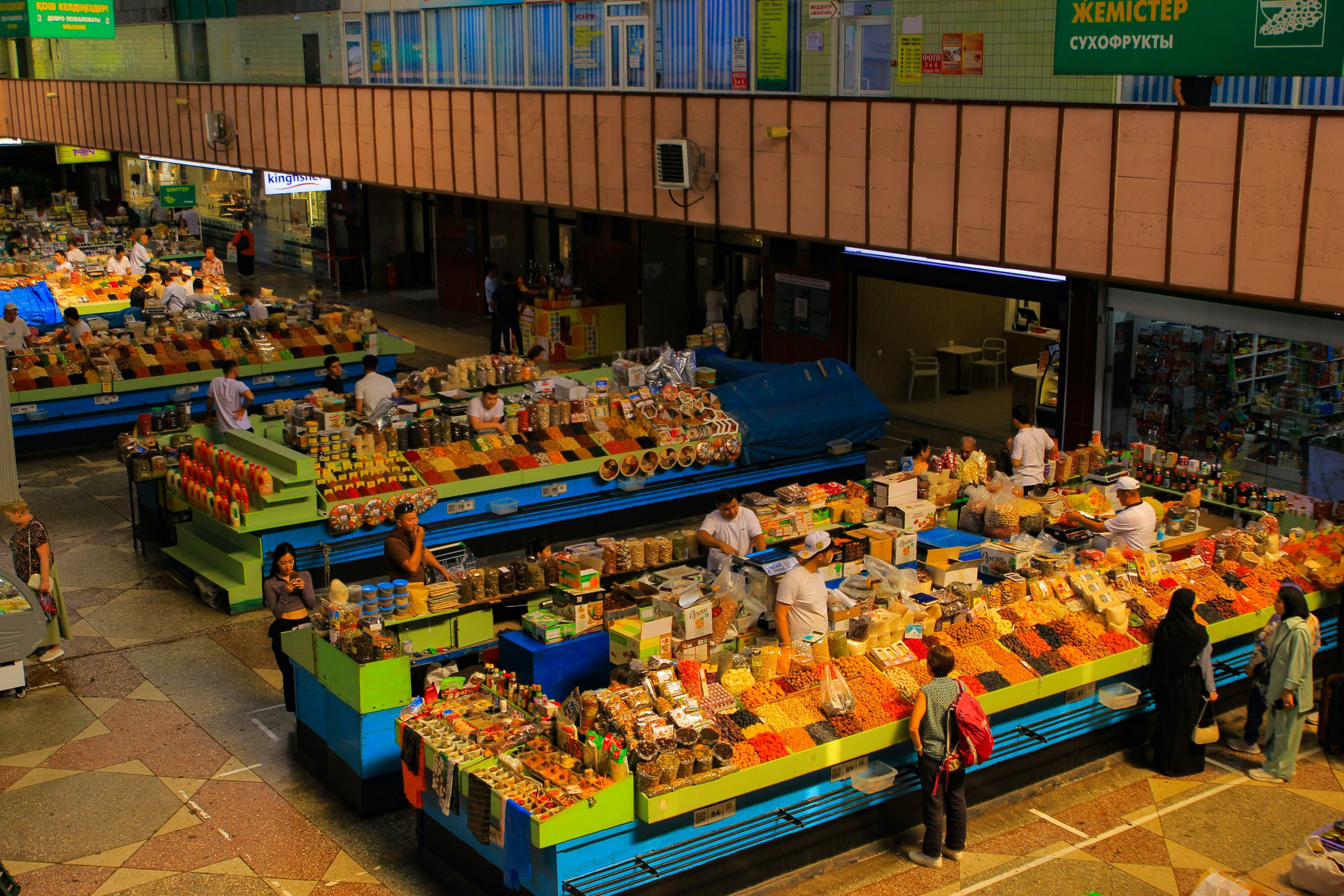


Our vision and why it matters
Latest publications
-
![]()
What future for the Middle Corridor?
Sophia Nina B-A - January 2026
The International Railway Journal (IRJ)
London, UK.
-
![]()
Iran seeks new role as regional hub
Sophia Nina B-A - January 2026
The International Railway Journal (IRJ)
London, UK.
-
![]()
Russia’s First Oil Export to Afghanistan Via the Iranian Railways: a Closer Look
Sophia Nina B-A - December 2025
The Royal United Services Institute (RUSI)
London, UK.
-
![]()
What to Make of the $4.2 Billion Kazakhstan-US Locomotive Deal?
Sophia Nina B-A - October, 2025
The Royal United Services Institute (RUSI)
London, UK.
-
![]()
Why Central Asia Focuses so Much on Railways
Sophia Nina B-A - September, 2025
The Royal United Services Institute (RUSI)
London, UK.
-
![]()
Russia’s Plans Are Bigger Than Conflict With the West or Camaraderie With China
Sophia Nina B-A - May, 2025
The Diplomat, Washington DC.
-
![]()
The View From the Ground: China’s Evolving Strategy in South and Central Asia
Sophia Nina B-A - October, 2024
The Diplomat, Washington DC.
-
![]()
Explaining South Korea’s railway ambitions in Central Asia
Sophia Nina B-A - August 2024
The Diplomat, Washington DC.
-
![]()
The ‘Corridorizing’ of Asia: Cooperation, Competition, and Consequences
Sophia Nina B-A - July, 2024.
The Diplomat, Washington DC.
-
![]()
Russia expands oil trade south via Afghanistan as it seeks warm water ports
Sophia Nina B-A - May 2024
The Diplomat, Washington DC.
-
![]()
In importing Russian gas, Pakistan treads a fine line
Sophia Nina B-A - July 2023
The Diplomat, Washington DC.
-
![]()
Kazakhstan is vulnerable to secondary sanctions
Sophia Nina B-A - June, 2023
The Diplomat, Washington DC.
-
![]()
Afghanistan-Iran completes first trial run of Khaf-Herat Railway
Sophia Nina B-A - June, 2023
The Diplomat, Washington DC.
-
![]()
Uzbekistan and Russia energy relations: a tale of two problems
Sophia Nina B-A - May, 2023
The Diplomat, Washington DC.
-
![]()
The Strategic Logic of Russia’s Embrace of the Taliban
Sophia Nina B-A - April, 2023
The Diplomat, Washington DC.
-
![]()
Kazakhstan and Afghanistan seek to realign bilateral ties
Sophia Nina B-A - March, 2023.
The Diplomat, Washington DC.
-
![]()
New Hopes for Old Projects? China gears up rail efforts with Kazakhstan
Sophia Nina B-A - March, 2023.
The Diplomat, Washington DC.
-
![]()
Afghanistan Seeks New Air Corridors
Sophia Nina B-A and Mads Schmidt.
March, 2023 - The Diplomat, Washington DC.
-
![]()
Just passing through: Kazakhstan’s parallel trade predicament
Sophia Nina B-A - March, 2023.
The Diplomat, Washington DC.
-
![]()
After a temporary suspension, what’s next for the Trans-Afghan railway?
Sophia Nina B-A - February, 2023.
The Diplomat, Washington DC.
-
![]()
Trial Run for China-Afghan Rail Corridor as SCO Summit Kicks Off
Sophia Nina B-A - September, 2022.
The Diplomat, Washington DC.
-
![]()
The Trans-Afghan Railway line: Back on Track?
Sophia Nina B-A - July, 2022.
The Diplomat, Washington DC.
-
![]()
The Russia-Ukraine Conflict: Implications for Kazakhstan’s Energy Sector
Sophia Nina B-A - May 2022.
The Diplomat, Washington DC.
-
![]()
China and Uzbekistan: An emerging development partnership?
Sophia Nina B-A - May, 2022.
The Diplomat, Washington DC.
-
![]()
Mixed fortunes for Kazakh grain?
Sophia Nina B-A - April, 2022.
The Diplomat, Washington DC.
-
![]()
India’s plan to realise TAPI
Sophia Nina B-A - April, 2022.
The Diplomat, Washington DC.
-
![]()
Uzbekistan looks south for new trade routes
Sophia Nina B-A - April, 2022.
The Diplomat, Washington DC.
Our videos
-
![]()
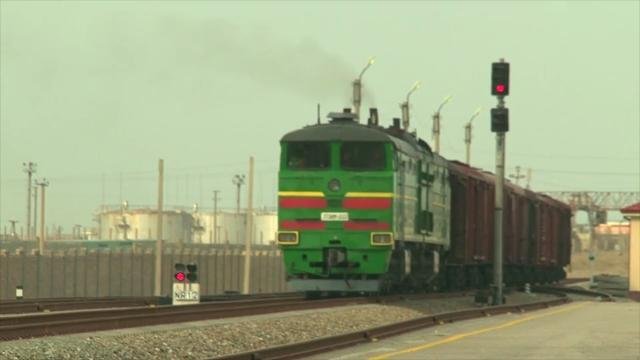
Kazakhstan seaports, roads and railways
-
![]()
Tajikistan/Afghanistan. border connections
-
![]()
Tajikistan/Afghanistan - the road network
-
![]()
Update on my research journey from Uzbekistan
-
![]()
Uzbekistan: Nukus-Beynou railway line
-
![]()
India railways, seaports, and roads