Feeding a Growing Population: Logistics Challenges Facing Food Security in Central Asia
By Charles McCloy
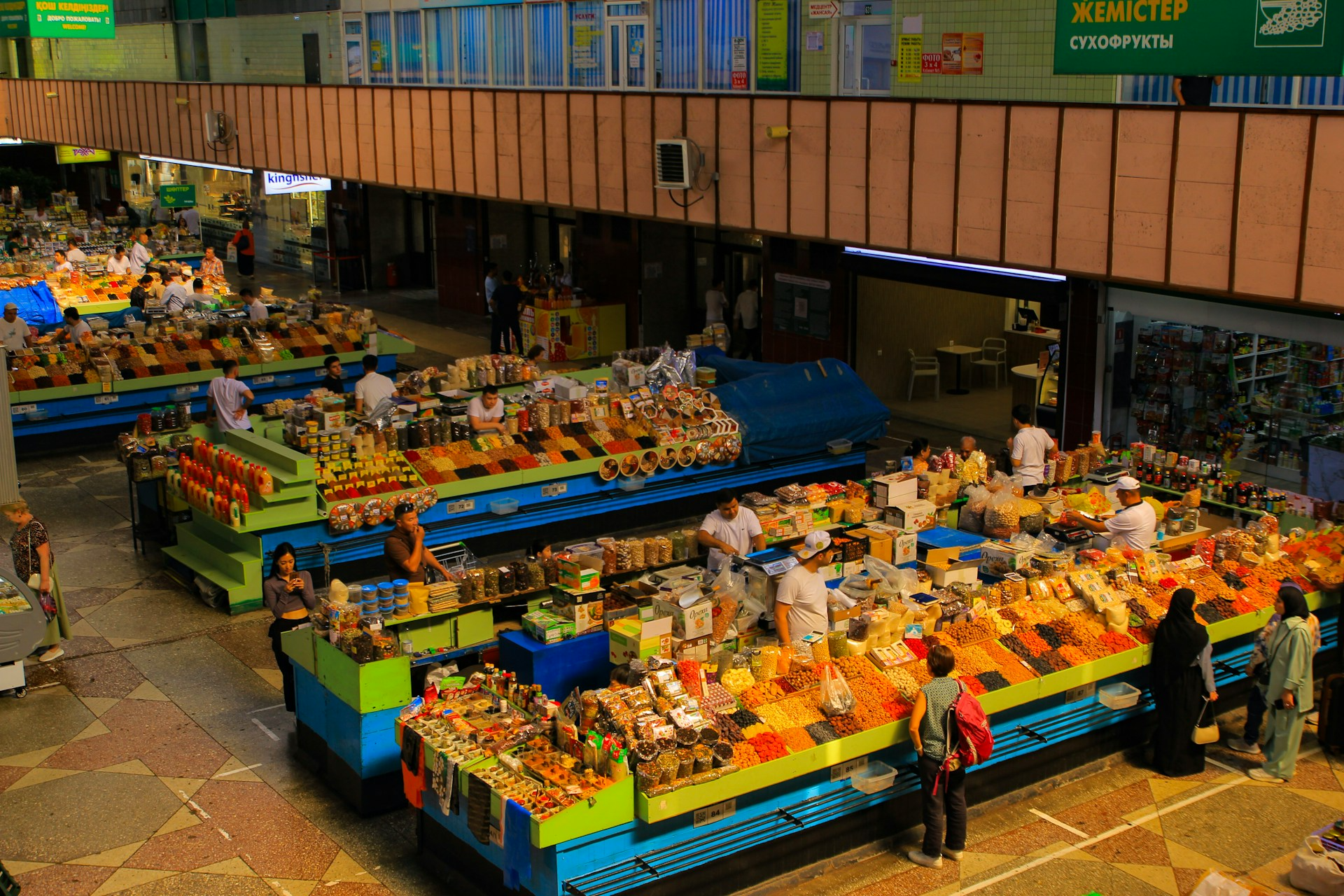
The Green Bazaar in Almaty, Kazakhstan.
In this first article of a series, we will discuss the supply chain in Central Asia and how it affects food security in the region. It comes amid the recently signed ‘Central Asia Food Security Plan through 2030’ by the Central Asian agriculture ministers on 11 November 2025 in Uzbekistan. We unpack: where we’re at now, what’s causing the logistical challenges and offer practical strategies to close the gap.
In short: access to food and its availability through a robust supply chain network is central to food security, especially in emerging economies. It is a social and economic challenge which has an impact on the health and success of a nation that is closely tied to issues such as population growth, logistics and transport infrastructure, and agricultural practice. This article will focus on infrastructure in particular and how it is impacting the food supply chain in Central Asia.
The Importance of Food Security in Central Asia
Over the last decade, the economies in Central Asia have grown considerably as countries such as Kazakhstan, Kyrgyzstan, Uzbekistan, and Tajikistan have made progressive reforms to open up to international investment. Visible change in major cities and certain areas of the economy has been coupled with increasing affluence and a growing population. As of 2025, the regional population is 84.1 million and is expected to exceed 100 million by 2050, according to the UN.
In simple terms a growing population means there will be more mouths to feed. This means that more food will need to be either produced or imported, which in turn, places greater stress on the supply chain and the need for modern solutions to meet increased demand.
This is a significant issue given that food loss in the region is already particularly high. According to the Eurasian Development Bank (EBD), it is estimated that approximately 14 million tonnes of food is lost each year. This equates to 167 kg / capita of food that is lost post-harvest and before retail. This is compared to an estimated figure of 118 kg / capita as a global average (this is based on the Food and Agriculture Organisation (FAO) – Food Loss Index).
Analysing the reasons behind this, there is a lack of supporting infrastructure through a modern storage and transport network in Central Asia which is impacting the supply chain from farm to fork. This is in comparison to developed economies in western Europe and the US where food loss remains an issue, but there has been greater investment in solutions through the development of new warehousing or technology.
Central Asia suffers from a lack modern cold storage facilities both at point of production for raw materials and post-processing for finished goods. These are necessary to ensure that certain products are kept at chilled or frozen temperatures to prolong lifetime and nutritional value. Where data is available, we have analysed capacity per capita against total capacity. As the table below shows, capacity per capita in the region is in stark contrast compared to nations with more developed cold storage supply chains:
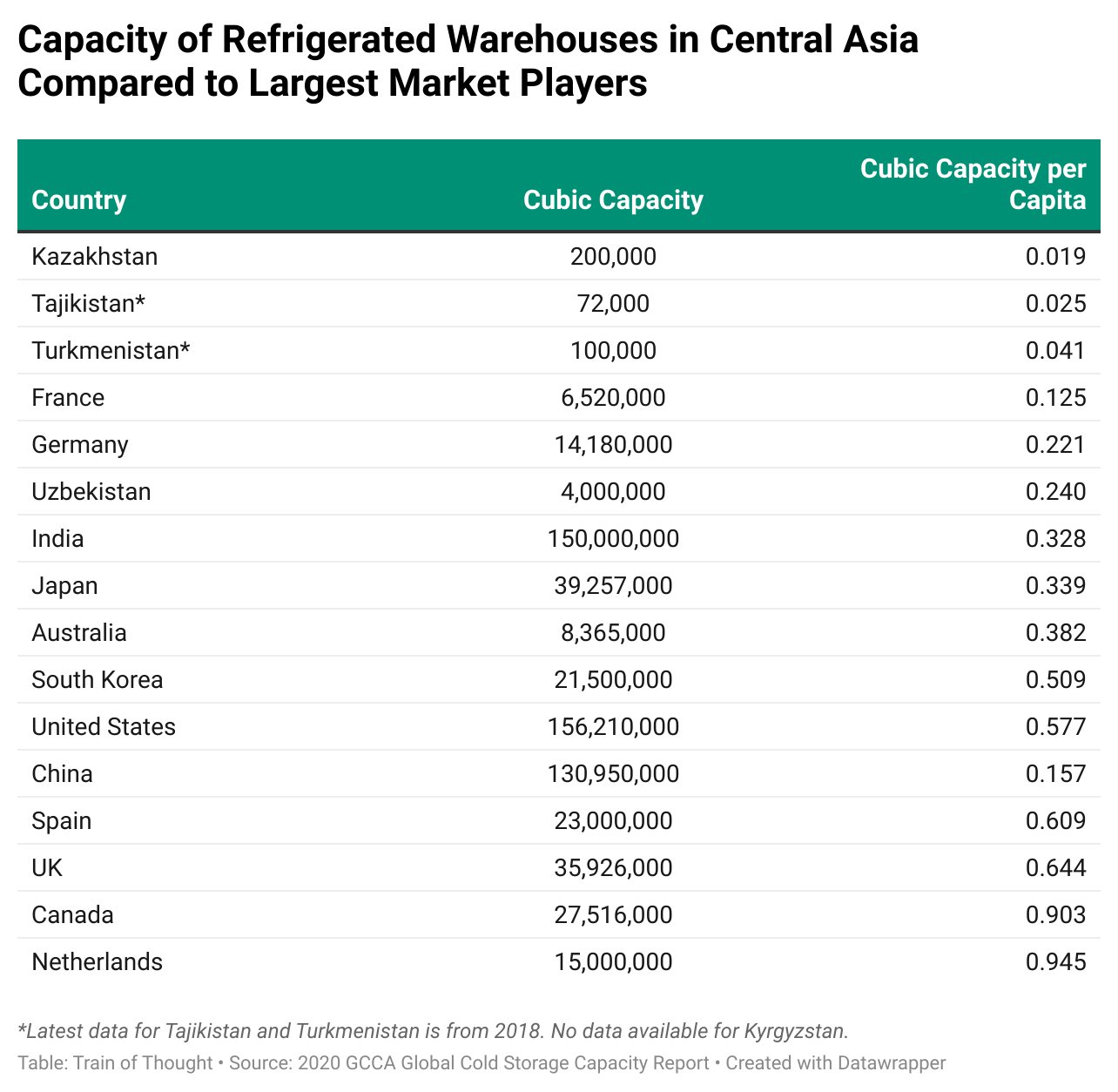
Interestingly, capacity per capita in Uzbekistan is higher than in France, Germany and Italy (not listed). However, the data does not take into account the age or quality of warehouses. Since 2020, in both France and Germany, major third-party logistics (3PL) operators have been acquiring or developing new facilities of scale and quality. In Uzbekistan, there has been less investment; the market is generally characterised by ageing stock that is not fit for purpose (to note: a more in-depth analysis on the cold chain in Central Asia vs Western Europe will be explored in a future article).
Whilst Kazakhstan, Tajikistan, and Turkmenistan are at the lower end of the range against nations in the table, it is in line with developing countries such as South Africa (0.069 / capita), Vietnam (0.074 / capita), and Kenya (0.038 / capita). Indeed, there is a correlation between a lack of capacity and food waste. Data per country is not available, but in nations where storage capacity is greater (e.g. North America and Europe), food loss post-harvest was 9.20%, according to the latest estimates by the FAO. This is compared to up to 40% in developing countries, depending on the state of the cold storage supply chain and infrastructure network for transport.
Refrigerated trucks and proper packaging of goods are key to the supply chain, also. If exposed to high temperatures for prolonged periods, perishable goods (fruits, vegetables) spoil before they reach markets or processing facilities. This is combined with an ageing road and rail network, much of which has not been modernised since the fall of the Soviet Union. Furthermore, geographical obstacles such as being landlocked (Uzbekistan, Kyrgyzstan, Tajikistan) result in transport costs in Central Asia being some of the highest in the world due to their inaccessibility and make operating a modern transport fleet expensive.
Impacts on Trade
Ultimately, these issues result in a trade imbalance as Central Asia is reliant on importing staple food products rather than producing them. In 2023, Kazakhstan, Uzbekistan and Kyrgyzstan imported a total of $11.6 billion in food products, which is almost double the amount imported in 2020: $5.8 billion (according to the US Department of Agriculture, USDA). Whilst exact trade figures are not available for Turkmenistan, the only country which exports more agricultural products than it produces is Kazakhstan.
However, the overreliance on imports has its own risks and makes the countries sensitive to price inflation and global disruptions affecting commodity markets.
In particular, Kyrgyzstan and Tajikistan are more vulnerable due to their mountainous terrain, resulting in the conditions for food production and accessibility being more difficult. This results in a greater dependence on outside sources.
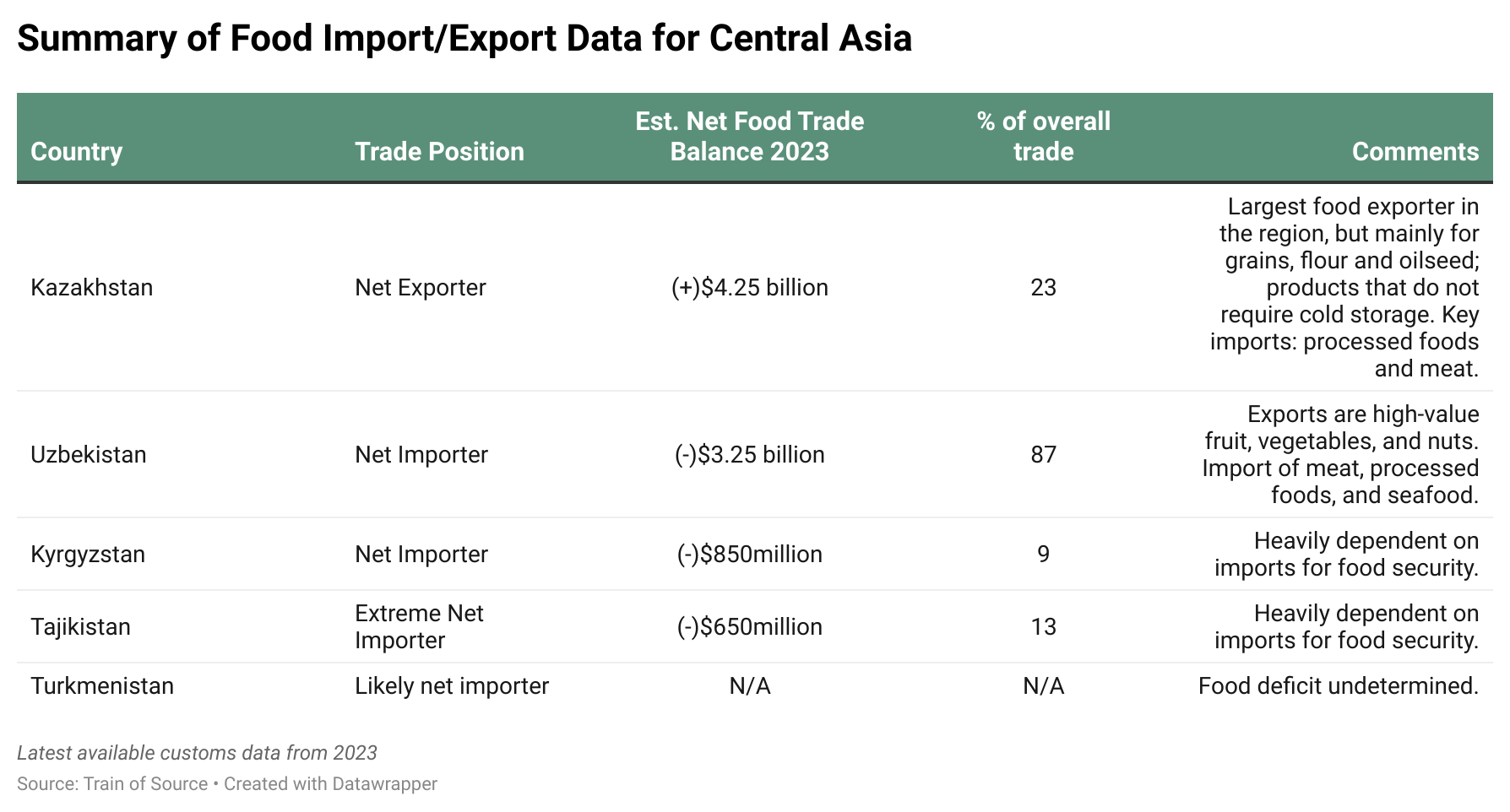
Perishable items such as fruit and vegetables in Uzbekistan are key export items to countries such as Russia. Many of the cold storage warehouses to store these goods are either located in growing regions such as Fergana or close to transport hubs in the Tashkent region. However, the absence of a modern cold chain has resulted in up to 30% of all fresh produce being wasted due to a lack of capacity (according to global fresh produce trade platform Fresh Plaza).
Indeed, in Uzbekistan, it is estimated that cold storage capacity only covers 4.90% of the country’s total fruit and vegetable output. This has a significant impact on producers growing their businesses and impedes the ability to access markets further afield and stabilise supply to local cities. It results in low return cycles and hinders back crop diversification.
Conclusion
Trade critically impacts Central Asian food security and demonstrates a structural inability to feed the population from domestic resources. This exposes people to global commodity shocks, which translates into domestic food inflation. Combined with an outdated supply chain, they create setbacks which exacerbate these vulnerabilities at a time when the economies of Central Asia are growing rapidly in other sectors.
Arguably, a lack of modern cold storage solutions and strong supporting transport infrastructure is the greatest impediment due to the amount of food lost, as it is inflating demand and leading to significant trade deficits. In turn, this is creating a financial drain on the food system across the region.
However, positive efforts to address the issue are being made to create a more resilient food supply chain and as demonstrated by government initiatives such as the Central Asia Food Security Plan through 2030, which was jointly signed in November 2025 by the five countries.
In a future article, we will assess the differences in the food supply chain in Central Asia versus other countries and examine particular case studies, as well as consider efforts being made by governments and businesses to address the situation.