Challenges and Opportunities for Post-War Syria’s Railway Sector
By Sophia Nina B-A
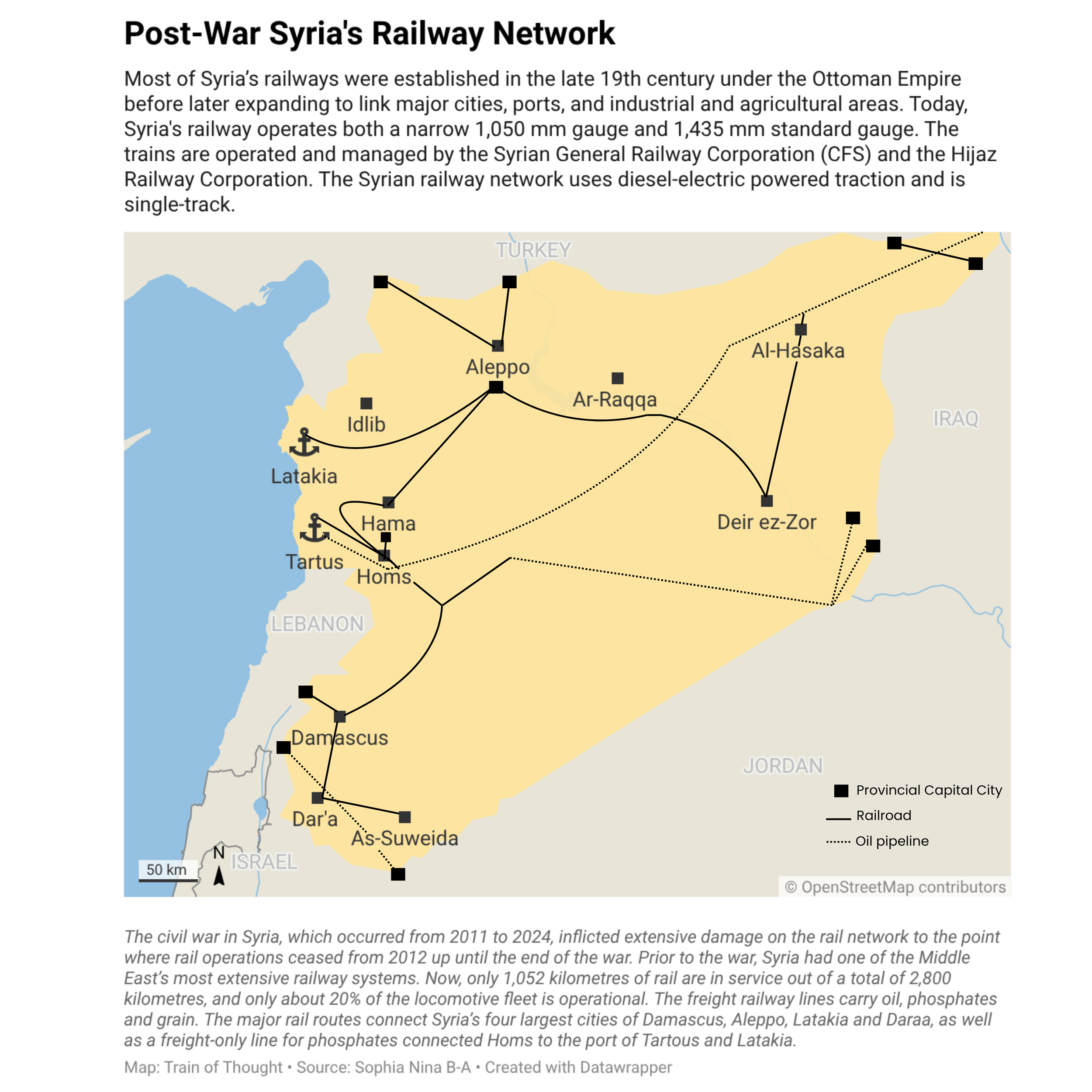
I created a map of Syria’s railway network, as there are no recent maps available. The coordinates and railroads I used are based on the UN Geospatial published on 1 August 2022, which shows the expressways, main roads, railroads, and oil pipelines across Syria, and I used Datawrappr to map the railway network using this data and also triangulated it with my research work.
The current state of Syria’s railway network
The civil war in Syria, which occurred from 2011 to 2024, inflicted extensive damage on the rail network to the point where rail operations ceased from 2012 up until the end of the war. Prior to the war, Syria had one of the Middle East’s most extensive railway systems.
Most of Syria’s railways were established in the late 19th century under the Ottoman Empire before later expanding to link major cities, ports, and industrial and agricultural areas.
The major rail routes connect Syria’s four largest cities of Damascus, Aleppo, Latakia and Daraa, as well as a freight-only line for phosphates connected Homs to the port of Tartous.
According to the World Bank, during the first decade of the 21st century, trains carried goods and passengers throughout the country, and transported over 3.5 million passengers and more than 8 million tonnes of goods in 2010. As we know, railways derive their value through their connections to seaports and inland logistical ecosystems. Before the war in Syria, goods heading as far afield as Iraq used to come through Lebanese ports to avoid the voyage through the Suez Canal and around the Arabian Peninsula.
The country’s descent into civil war disrupted this commercial order. The World Bank estimates the cost of rebuilding the physical assets of transport infrastructure at about $82 billion, including road networks, railways, ports, energy and water supplies, communications and information technology. In terms of the railways, the Syrian transport Minister Yarub Badr said Syria needs $5.5 billion to repair and modernise the railways in line with international standards.
Only 1,052 kilometres of rail are in service out of a total of 2,800 kilometres, and Syrian government officials estimate the repair of Syria’s transport sector’s infrastructure to take between three and five years to return to full operation. Osama Haddad, director general of the Central Railway Services Co., noted that only about 20% of the locomotive fleet is operational.
The main goods that are carried by rail in Syria are grain, phosphate, and oil. These commodities play a key role in Syria’s economy. Since 2025, the movement of oil, phosphate and grain by rail has seen gradual activity that is still in its early stages.
Signs of growing confidence in Syrian rail?
After the government of President Bashar al-Assad was overthrown by a coalition of armed opposition groups, led by Hay’at Tahrir al-Sham (HTS) on 8 December 2024, Syria entered a fragile transition under the now Syrian President Ahmed al-Sharaa, the leader of HTS.
The US has provided sanctions relief to al-Sharaa’s regime, and most commercial activity is now legally permissible under certain conditions. In April 2026, the US government published a ‘Doing Business’ Syria Investment Guide for investors, which provides a more detailed overview of navigating the legal and regulatory steps of doing business in Syria.
Efforts have continued, and interest in repairing the railways remains.
January 2025: As the new Syrian Government announced that all contracts under the previous Assad government are cancelled, the Russian Foreign Ministry announced that they were negotiating with the Al-Sharaa government to continue the agreement on the management of the port of Tartus, where the Russian Navy’s logistics base has been located. This contract was signed between the countries back in 2017 and was intended to be valid for 49 years.
January 2025: In the same month, the Syrian national railway authorities announced the launch of the first grain trial freight train on the Latakia–Aleppo line, passing through Homs and Hama, after a suspension of nearly 15 years.
17 May 2025: Syrian authorities have signed an agreement with the UAE’s DP World, the world’s largest port operator, for an $800 million investment in the development of terminals and logistics infrastructure at the Port of Tartus. This was the new Syrian government’s first major international contract since the country’s new government terminated an investment agreement with the Russian company STG Engineering in January 2025. Under the 2019 agreement, the Russian side was to invest over $500 million in port modernisation and manage it for 49 years. This came following the US’s conditional sanction waiver on Syria. However, Russian military bases in Tartus on the Mediterranean coast and Khmeimim remain.
6 August 2025: The Syrian government signs a $2 billion deal with the UAE’s national investment corporation for plans to build the Damascus Metro project.
2 September 2025: 600,000 barrels of oil were shipped for export through the Mediterranean port of Tartus (Syria), which is under a 30-year concession agreement with DP World. This is the first official shipment of hydrocarbons sent from Syria for export in the last 14 years.
23 September 2025: Turkey agreed to fund the reconstruction of 30 km of railway in Syria, which was destroyed during the civil war, Turkish Transport Minister Abdulkadir Uraloğlu announced following a meeting between transport officials from Turkey, Syria and Jordan. Jordan announced that it will assess its technical capacity to support the maintenance, repair and operation of locomotives within Syria. The three countries also plan to conduct joint technical studies aimed at enhancing Türkiye’s access to the Red Sea via Jordan’s Port of Aqaba.
September 2025: Syrian Ministry of Transport signs an MoU with a Qatari company Future Union to expand rail cooperation. This includes the exchange of expertise, developing and operating railway projects, a feasibility study for establishing new lines, and the possibility of supplying modern trains.
15 October 2025: The Syrian Ministry of Transport had a meeting with the China Civil Engineering Construction Corporation (CCECC) and the China Railway Construction Corporation (CRCC) to discuss prospects for cooperation in land and railway transport projects.
20 November 2025: Syria’s Minister of Transport, Yarub Badr discussed with representatives from Dorsch Global, a German company specialising in railway infrastructure, to discuss the upgrade of the phosphate transport rail line from the Homs mines to the port of Tartous. The project aims to increase the line’s annual capacity to 4.3 million tonnes. During a video conference, Minister Badr invited the German team to conduct a field visit to the rail line, from the mines to the port, to assess the technical condition on-site, identify specific needs, and ensure the accuracy of the studies before proceeding with the project.
15 January 2026: The Syrian Ports Authority signed a contract with Turkey’s Kuzey Star Shipyard to introduce shipbuilding in Syria under international standards and for the construction of a fully integrated shipyard in Tartus Port under a build–operate–transfer (BOT) model. Kuzey Star Shipyard will build, equip, operate, and manage the facility. According to the contract, the investment will run for 30 years, with Kuzey Star committing at least $190 million over the first five years to develop docks, warehouses, and operational infrastructure. The agreement places no financial obligations on the Syrian side. The deal also grants a 20% discount on shipbuilding and repair services for Syrian government vessels, while requiring the company to provide 1,700 direct jobs and 3,500 indirect jobs, with at least 95% of the workforce to be Syrian. Training and technology transfer are also mandated.
22 February 2026: Syria secured a $50 million funding package to support priority transport projects. This includes the purchase of new locomotives and a technical assessment of existing railway engines to determine maintenance and modernisation requirements across Syria’s rail network. The World Bank also discussed the proposed phosphate transport corridor.
In March 2026, Syria released its first national post-war recovery roadmap. The government’s ‘Statement of Recovery Priorities’ sets out a national strategy for reconstruction and is built on what Al-Sharaa calls four “interconnected pillars.” The plan includes rebuilding Syria’s infrastructure as a top priority.
In April 2026, Syria’s Transport Ministry stated that discussions are underway with the World Bank to provide technical and financial support for Syria’s railway lines, with an estimated value ranging from $65 million to $200 million in grants, with priority focused on repairing the phosphate corridor and establishing a transit corridor linking Türkiye with Syria, Jordan and Iraq.
Current Major Railway Projects
Syria’s transport minister Yarub Badr stated that the government's priority is ‘fixing the corridor linking the phosphate mines to the export port in Tartus to bring it back online as soon as possible, in addition to reactivating the line between Latakia Port (western Syria) and the dry port in Aleppo (northern Syria)… The General Establishment of Syrian Railways has set an emergency short-term plan for immediate, minimal repairs alongside the restart of parts of the network, as well as a five-year plan for comprehensive rehabilitation that could be accelerated by leasing heavy machinery instead of purchasing it.’
Other railway projects include:
Container railway line from Lattakia port to the Sheikh Najjar dry port in Aleppo.
Railway line connecting the Maydan-Ikbis border crossing with Turkey to Aleppo.
Damascus – Homs – Hamah – Aleppo – Maydan Ikbis (- Ankara TCDD)
Damascus Metro project – link Damascus with its countryside (Rif Dimashq governorate) via a regional rail network, consisting of two main lines intersecting at al-Hejaz Station (central Damascus), from which four branch lines would depart.
The Hejaz Railway project: a modern extension of the historic Ottoman-era Hejaz Railway, which connected Turkey to Saudi Arabia via Jordan and Syria, with branch lines extending to Lebanon. If successful, the railway is expected to connect with the Gulf railway network and extend further to Oman and the Arabian Sea, creating a land corridor that could serve as an alternative to routes dependent on the Strait of Hormuz.
Digital transport initiatives – including an electronic cargo platform, vehicle registration system, ticket booking and payment platforms, and integrated electronic scales at ports and border crossings. The two sides examined the potential for high-speed rail systems reaching speeds of 250 km/h, noting that implementation will depend on detailed economic feasibility studies and financing mechanisms.
Outlook
Despite an encouraging opening for investors, the railway sector faces significant challenges. Poor infrastructure, weak signalling systems, and outdated rolling stock (only around 25 locomotives remain in service nationwide) are challenges that the government needs to tackle before Syria can emerge as an efficient logistics transit hub in the Middle East. As mentioned above, the cost to reconstruct Syria’s railway network is estimated to require between $3 billion and $5 billion. The network’s design also adds to the challenge. Most of the railways are single-track, so trains cannot pass each other without planned coordination, and this adds to the long delays. In order to handle the volumes of a new corridor or a high-speed rail project, the government would need double or triple tracks, introduce modern signalling systems and increase its rolling stock.
In addition, different sections of the Syrian railway network are operated and managed by two separate organisations. The Hijaz Railway Cooperation is in charge of the rail lines located between Damascus, the surrounding countryside and Daraa, in the south. The rest of the provinces are served by a different line, which is managed by the state-owned Syrian Railways Corporation.
Private sector investment remains low in the railways sector due to political risk, sanctions, return on investments and security concerns such as the ongoing struggle of al-Sharaa’s regime to pacify militant groups internally and the intensification of Israeli operations in southern Syria. That being said, the conflict in the Middle East and blockades on the Strait of Hormuz have emphasised a greater need for options with transport routes. The growing signs of international engagement and Syria’s favourable geographic position on the eastern coast of the Mediterranean are promising, but the security and political risk concerns remain a lurking problem.