Country Comparison of Poland and Uzbekistan’s Cold Storage Sector
By Charles McCloy

Following on from our previous article about the cold storage sector in Uzbekistan, in this one we will compare the state of the Uzbek market with Poland, which has similar characteristics in terms of population and cold storage capacity. We will also assess potential solutions for the Uzbek cold storage sector as it seeks to modernise and meet the food demands of a growing population.
Similar Recent History, Different Trajectories
Uzbekistan has a population of c. 36.6 million people. This is broadly in line with the population of Poland, which stood at 36.5 million in 2025, according to Eurostat. It is interesting to compare these two countries, given that both have had a similar recent history in the twentieth century and were faced with the enormous challenge of modernising their economies after the fall of communism.
Over this period, Poland’s economy has developed at a pace; it has become a major hub for trade and professional services, and has witnessed wealth creation. This has resulted in its nominal GDP per capita is 6.7x higher than Uzbekistan’s, according to the IMF. Indeed, Poland has become an attractive Core+ market for private equity and real estate investors looking to expand their portfolios, drawn to the higher yield premiums compared to more saturated markets in Western Europe. This has manifested in the growth of sectors such as logistics by major international developers such as Pannatoni and Logicor and resulted in the creation of modern industrial markets in Warsaw and regional cities such as Lodz, Katowice, and Poznan.
Whilst the Uzbek economy is growing, it has not yet received the same level of outside investment. This is in part due to an element of catch-up, as major reforms to liberalise the economy have only been introduced since President Mirziyoyev came to power in 2016. Sectors such as logistics are gaining traction as developers (Orient Logistics Group) and international companies (Rhenus Logistics, CEVA Logistics) are starting to emerge.
Ageing Cold Storage Markets with Different Approaches to Modernise
As with cold storage in many countries across Europe, in Poland and Uzbekistan it has been overlooked whilst more attention has been paid to industrial & logistics instead. In both countries, the cold storage market is generally characterized by aging stock that is reaching the end of its economic life.
In Poland, we have conducted research into the ages of stock in the market and have estimated 54% of cold storage to be over 20 years in age. Whilst we do not have precise figures in Uzbekistan due to less transparency of data, existing stock is typically aging and of poor quality.
Research by the GCCA in 2020 showed that the supply of the cold storage market in both countries was similar on a per capita basis, mirroring the similar sizes in population:
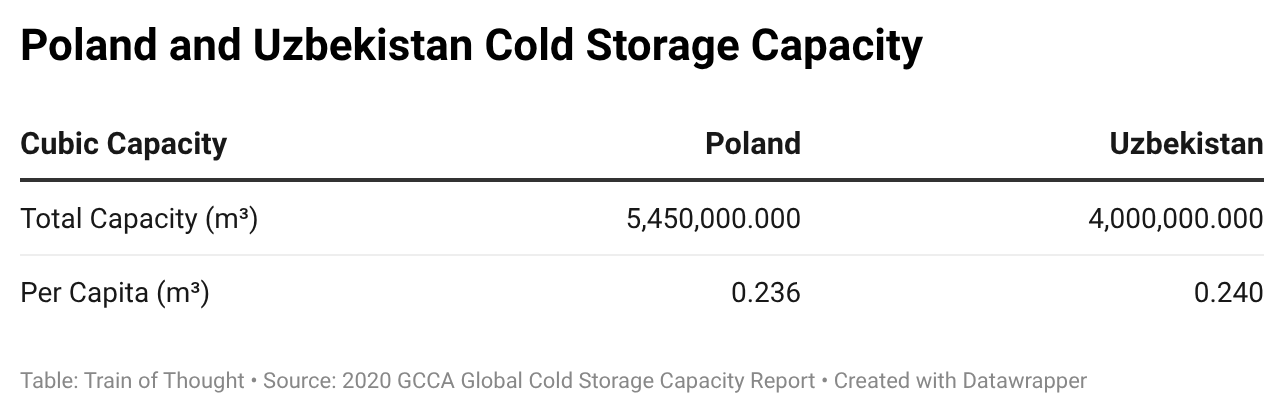
We acknowledge that this data is slightly old now as new stock has come online, but it does provide a useful benchmark to compare the two markets.
Despite this, the quality of the capacity would be considered to be far superior as it has received outside investment from major players that have entered the market either through M&A or development of their own facilities in recent years. The world’s largest operator Lineage entered the market in 2020 through the acquisition of Pago, previously Poland’s largest operator with six facilities. This is following Americold’s acquisition of AGRO Merchants (also in 2020) which included two facilities in Gdansk and Gydnia. AGRO Merchants had previously acquired these facilities from local businesses.
These acquisitions consist of conventional cold storage facilities, which is in line with the majority of the stock in Poland. However, the development of automated cold storage facilities at scale in recent years has brought greater sophistication to the market, bringing it in line with the most modern facilities elsewhere in Europe. NewCold has been the key driver of this and specialise in the development and operation of automated facilities. NewCold opened its first automated facility in Kutno in 2015, before expanding it in 2024 to total 112,000 pallets. Following this, NewCold completed a second facility in Modlin, outer Warsaw in 2025 of 94,000 pallets. Both facilities operate at significant scale and represent the largest facilities in Poland. Finally, Nichirei through its Frigo Logistics platform also completed an automated facility of c. 30,000 pallets in outer Warsaw in 2025.
Cold storage stock in Uzbekistan is made up of manually operated facilities that are predominantly run by private enterprises. It has not had the development of an automated facility yet and the existing stock is typically small scale facilities of under 10,000 pallets. The issue is that this does not meet the requirements of a population that is forecast to exceed 50 million people by 2050, according to estimates by the UN. As mentioned in our previous article, the majority of the stock is either located in the Tashkent or Samarkand regions (population centres) or in growing areas such as Fergana (at source).
Uzbek Cold Storage Market at an Early Stage in its Maturity Cycle
It is clear that Uzbekistan’s cold storage lags behind modern standards and requires modernisation. Initiatives such as the government backed UzAgroLogisticsCenters project are much needed, but further investment into the sector will be needed to reduce the high levels of food waste (c. 30% of all fresh food annually) and support existing stock which will cease to function without major Capex upgrades.
In Europe, the market is evolving through the attraction of major players in the sector and the development of modern cold storage facilities of scale, whilst older facilities will be phased out with time. The Uzbek market has not reached this phase in its cycle yet and investment in the country poses its own challenges. However, it would be pertinent to follow progress in countries such as Poland, which serve as a template to implement greater sophistication in the future.